Coffee, tea or Internet access?
It sounds strange now, but that phrase isn't as far from
reality as one might think. Not if George Wimbish has his way.
As president of Mobile Area Networks Inc. of Heathrow,
Wimbish is bringing wire-free Internet access to commercial buildings, such
as hotels.
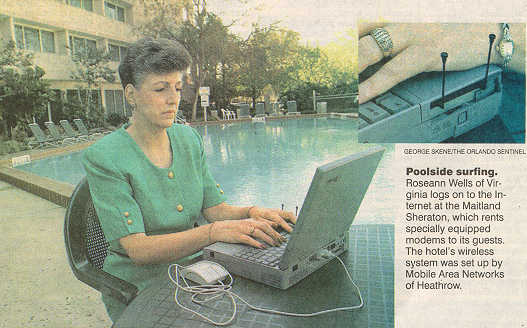
Using specially equipped modems rented from the hotel,
travelers with laptops can access the Internet from anywhere on the
property, including the hotel's restaurants, conference rooms or even the
pool.
On a recent morning at the Sheraton in Maitland, Wimbish
browsed the Internet and read e-mail while munching on his bacon-and-egg
breakfast in the hotel's restaurant. His laptop wasn't attached to a phone
or cable line, but Web pages popped up with lightning-quick speed.
Wimbish pointed to a tiny antenna on a beam above diners.
The data received by his computer had traveled through fiber-optic lines to
a receiver in the hotel's equipment room and was beamed to a dozen or so
antennas scattered throughout the hotel.
Wimbish is one of a growing number of entrepreneurs who
are betting that wireless technology will supplant cable and phone lines as
the primary means of moving voice and data. As it overcomes hurdles such as
cost and reliability, wireless is making possible the development of new
products and services that were unimaginable a few years ago.
"Wireless has the power and flexibility to make almost
anything happen from a technology standpoint," said Phil Asmundson, a
telecommunications analyst with Deloitte Consulting in Dallas.
Several companies in Central Florida have developed
products designed to take advantage of wireless's biggest strength --
allowing people to receive data free from phone jacks and cable lines:
AT&T Corp. built and manages a secure wireless network
for the Seminole County Sheriff's Department. In 1997, all patrol cars were
equipped with laptop computers that gave officers quick access to driving
records, criminal histories and color photos of people with prior arrests.
Officers can e-mail each other and can use the system to track the location
of fellow officers.
|
Wireless makes a connection
Greg Groeller
of The Sentinel Staff
Published in The Orlando Sentinel on
March 21, 1999.
Companies
finding
news ways
to use
Technology
to their
advantage
|
Advantor Corp. of Orlando uses a combination of
wireless signals and phone lines to monitor images sent by security
cameras in stores and businesses. Advantor is developing a host of
new products, including an electronic pill dispenser that sends a
wireless signal to the company when patients with life-threatening
ailments don't take their medicine on time. Advantor technicians
would then call the patients as a reminder.
ITEC Entertainment Corp. of Orlando pipes television ads and music
videos over phone lines to a special receiver in each of Foot
Locker's 230 stores around the world. The receiver then beams a
digital signal to televisions throughout the store. Programming can
be updated from ITEC's offices in Orlando.
American Millennium Corp. Inc. of Mount Dora
tracks rail cars, tanker trucks and ships at sea using wireless
technology. On-board sensors monitor variables, such as the
vehicles' location, fuel level or cargo temperature. The information
is then beamed via satellite to American Millennium's offices, where
it is sent over phone lines to clients' computers. The entire
process takes less than 60 seconds.
For wireless to take off, there are a few hurdles
it must overcome. One is cost. For some applications, replacing
phone lines and fiber-optic cables with transceivers and satellites
can more than double the price.
"The technology is there, but the real problem is
that it's hard to compete with phone and cable on cost," said Todd
Flemming, president of Advantor. "But that's changing as wireless
becomes more prevalent."
Reliability is another thorn in the wireless
industry's side. Although digital cellular technology is a vast
improvement from the days of analog cellular -- when garbled calls
and scrambled data transmissions were the norm -- the industry still
grapples with reliability problems. Wireless transmissions can be
interrupted by severe weather, fickle equipment or poorly located
transmission towers.
Finally, most wireless signals can't match
fiber-optic cable for the sheer volume of data it can carry. As a
result, most wireless networks usually start with a cable linked to
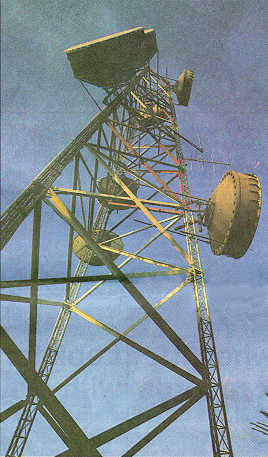
a transmission tower, which then beams the data over the airwaves.
Despite those limitations, proponents say
wireless's day is coming.
"This is the way everything will be done in the
future, not just in law enforcement but everywhere," said Sgt. David
Lohr of the Seminole County Sheriff's Department, who has used a
wireless laptop in his patrol car for more than a year.
[Posted 03/20/1999 12:59 AM EST] |
|
|